Key Takeaways
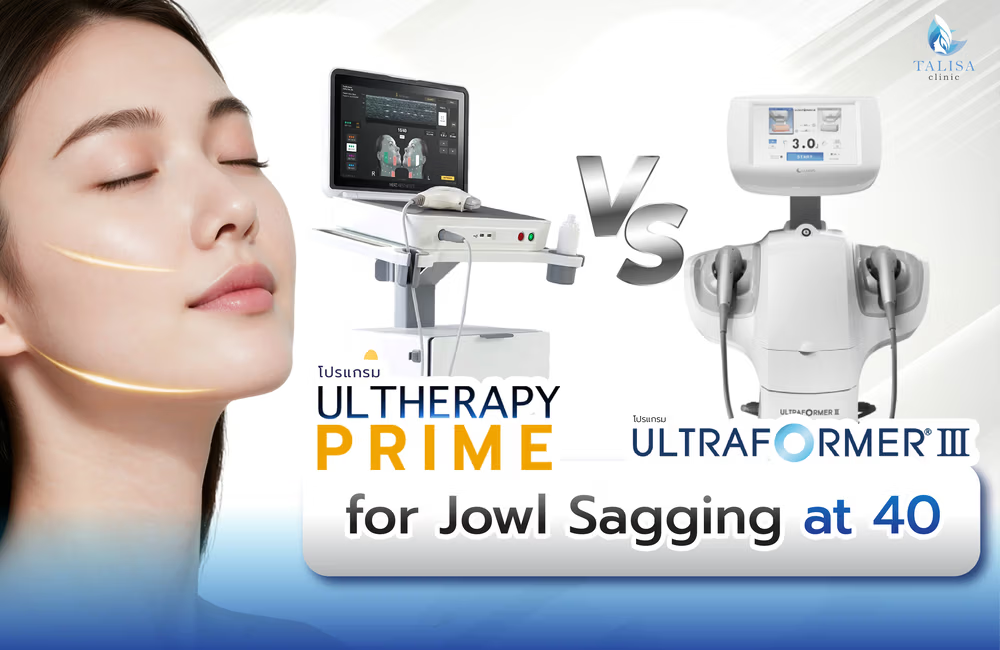
- Ultraformer III vs Ultherapy is a choice between two focused ultrasound lifts: Ultraformer III targets skin and localized fat at set depths, while Ultherapy adds real-time imaging to lift the deeper SMAS layer.
- For mild jowl sagging at 40 with some fullness along the jaw, Ultraformer III is often considered first, while laxity with little fat may suit Ultherapy better.
- At TALISA Clinic, Ultraformer III starts at 7,990 baht for 400 shots, and a doctor confirms the right treatment after assessment.
For mild jowl sagging at 40, both sides of the Ultraformer III vs Ultherapy question lead to a nonsurgical lift, and the better fit depends on what sits behind the jowl. When early laxity comes with some localized fat along the jawline, Ultraformer III is often considered because it works on skin and fat at different depths. When laxity is the main concern, Ultherapy, and the newer Ultherapy Prime, use real-time imaging to lift the deeper SMAS layer with precision. A doctor’s assessment of skin thickness and fat distribution settles the choice.
Both are widely requested by patients searching for HIFU in Bangkok or Ultherapy in Bangkok treatment options that refresh the jawline without surgery. This guide compares how each one works, what results to expect, and how pricing differs.
How Ultherapy Lifts the Deeper Layers
Ultherapy uses microfocused ultrasound with visualization. Energy is delivered to set depths beneath the skin, creating small thermal points that prompt new collagen to form over the following weeks. Its imaging transducer lets the doctor view tissue up to 8 mm below the surface in real time, so energy reaches the SMAS layer, the same support layer addressed in surgical facelifts, exactly where it was planned. Ultherapy Prime is the latest version of the same system and obtained FDA approval in February 2024.
Outcomes develop slowly and tend to be most evident after two to three months. In a study tracking patients over a year, 90 percent continued to observe improvement after one year. These attributes make Ultherapy an excellent choice when the primary issue is sagging skin and lack of support instead of surplus fat.
How Ultraformer III Works on Skin and Fat
Ultraformer III is a micro and macro focused ultrasound (MMFU) device made by Classys. Interchangeable cartridges deliver energy at different depths, and each depth has a role:
- 4.5 mm cartridge. Reaches the SMAS layer to lift the jawline, soften sagging cheeks and tighten the area under the chin.
- 3.0 mm cartridge. Works in the mid layer of the skin to stimulate collagen and help reduce localized fat, which suits early jowls and a fuller lower face.
Patients usually start to see changes within two to four weeks, with full results at around two to three months. Results typically last about 10 to 12 months, and patients can return to daily activities straight after treatment. At TALISA Clinic, the Ultraformer 3 treatment price starts at 7,990 baht for 400 shots, which makes it a practical option for routine maintenance. As a guide, each cheek uses around 200 shots, the area under the chin around 400 to 600, and the neck around 200 to 400.
Ultraformer III vs Ultherapy: Which Suits Mild Jowl Sagging at 40?
The two treatments share the same goal but take different routes to it. The table below sets them side by side:
Feature | Ultraformer III | Ultherapy (including Prime) |
Technology | Micro and macro focused ultrasound | Microfocused ultrasound with real-time imaging |
Main target | SMAS layers at set depths | Dermis and deep SMAS layer, guided by imaging |
When results show | From two to four weeks, full at two to three months | Builds over two to three months |
How long results last | About 10 to 12 months | Improvement reported within 12 to 18 months |
Pricing at TALISA Clinic | From 7,990 baht for 400 shots | Priced by lines after assessment |
Both methods are effective, non-invasive options for tightening the lower face. For a patient in their 40s with early jowls and some jawline fullness, Ultraformer is best suited for mild laxity or ongoing maintenance, typically performed twice a year to refine the jawline and treat mild fullness. For moderate-to-high laxity, Ulthera Prime provides deeper, imaging-guided structural lifting in a single annual session (once a year).

Why the Right Choice Depends on the Face
No single device suits every jawline at 40. Several factors shape the recommendation:
- Skin thickness. Thicker skin and thinner skin respond differently to energy at each depth.
- Fat distribution. Fullness along the jaw or under the chin points toward a treatment that also works on fat.
- Degree of laxity. Laxity in the deeper support layers benefits from precise, imaging-guided energy.
- Maintenance rhythm. Some patients prefer smaller, regular sessions, while others prefer a single treatment planned for the year.
What to Expect on Treatment Day
Both treatments begin with cleansing the skin and marking the areas to be treated. The doctor then guides the handpiece across the face, delivering energy in rows at the planned depths.
Sensation differs from person to person. With Ultraformer III, patients often describe brief, sharp pulses or a warm feeling beneath the skin that stays at a tolerable level. For Ultherapy, the average pain level was rated as moderate in a systematic review, and numbing cream is used beforehand to help keep patients comfortable. The duration of an Ultherapy Prime session generally ranges from 30 to 60 minutes, based on the number of lines and areas addressed.
After treatment, the skin may look slightly pink for a short time. Patients can usually return to work the same day, and the doctor provides aftercare advice suited to the treatment.
A Jawline Plan Built Around the Patient
Mild jowl sagging at 40 responds well to focused ultrasound when the treatment matches the cause. Ultraformer III suits early laxity with localized fat, and Ultherapy suits laxity in the deeper support layers.
TALISA Clinic is a doctor-led aesthetic clinic where every Ultraformer III session is performed by a doctor on a genuine device, and Ultherapy Prime is delivered on a genuine Merz Aesthetics system. Treatment plans are tailored to each patient’s facial structure, and the clinic has five branches, including Union Mall and Future Park Rangsit, open daily from 11:00 to 20:00.
Book a consultation today to find out which treatment best restores a defined jawline:
- LINE OA : @TALISAclinic
- Instagram : TALISAclinic
- Facebook : TALISA Clinic
- Tel : 062-486-3626
References
- 510(k) Premarket Notification K233996: Ulthera System (UC-1 Control Unit PRIME). Retrieved October 5, 2026, from accessdata.fda.gov
- Long-term Efficacy of Micro-focused Ultrasound with Visualization for Lifting and Tightening Lax Facial and Neck Skin Using a Customized Vectoring Treatment Method. Retrieved October 5, 2026, from pmc.ncbi.nlm.nih.gov/articles/PMC4771387
- Microfocused Ultrasound With Visualization (MFU-V) Effectiveness and Safety: A Systematic Review and Meta-Analysis. Retrieved October 5, 2026, from pmc.ncbi.nlm.nih.gov/articles/PMC11834976
Frequently Asked Questions About Ultraformer III vs Ultherapy (FAQs)
Q: Ultraformer III vs Ultherapy: which suits mild jowl sagging at 40?
A: Both lift the lower face without surgery. Ultraformer III is often considered when early jowls come with some localized fat, as it works on skin and fat at different depths. Ultherapy suits laxity in the deeper support layers, using real-time imaging to target the SMAS. A doctor confirms the better fit after assessing skin thickness and fat distribution.
Q: How many Ultraformer III shots does the jawline need?
A: As a general guide at TALISA Clinic, each cheek uses around 200 shots, the area under the chin around 400 to 600 shots, and the neck around 200 to 400 shots. The doctor sets the final number after assessing the face.
Q: Is there downtime after Ultraformer III or Ultherapy?
A: No, patients can return to their daily activities immediately after treatment with both Ultraformer III and Ultherapy. Temporary redness and mild swelling can occur with both machines, but these typically disappear within 3 to 7 days. Neither treatment causes bruising.
Q: How long do the results last?
A: Ultraformer III results typically last about 10 to 12 months. For Ultherapy, the lifting and tightening effects can last even longer, up to 12 to 18 months. Individual longevity varies depending on skin condition, age, and lifestyle.
🔥 Botox Promotion


ทำความรู้จักผู้เขียน

Talisa Clinic Team
เราเชื่อว่า “ความงามที่แท้จริง คือตัวตนที่ดีที่สุดของคุณ” ทาลิสาคลินิกจึงออกแบบทุกบริการให้เหมาะสมกับรูปหน้า ลักษณะผิว และความต้องการของแต่ละคนอย่างเฉพาะเจาะจง พร้อมด้วยทีมแพทย์ผู้เชี่ยวชาญเฉพาะทางด้านเวชศาสตร์ความงาม ที่ผ่านการอบรมทั้งในและต่างประเทศ